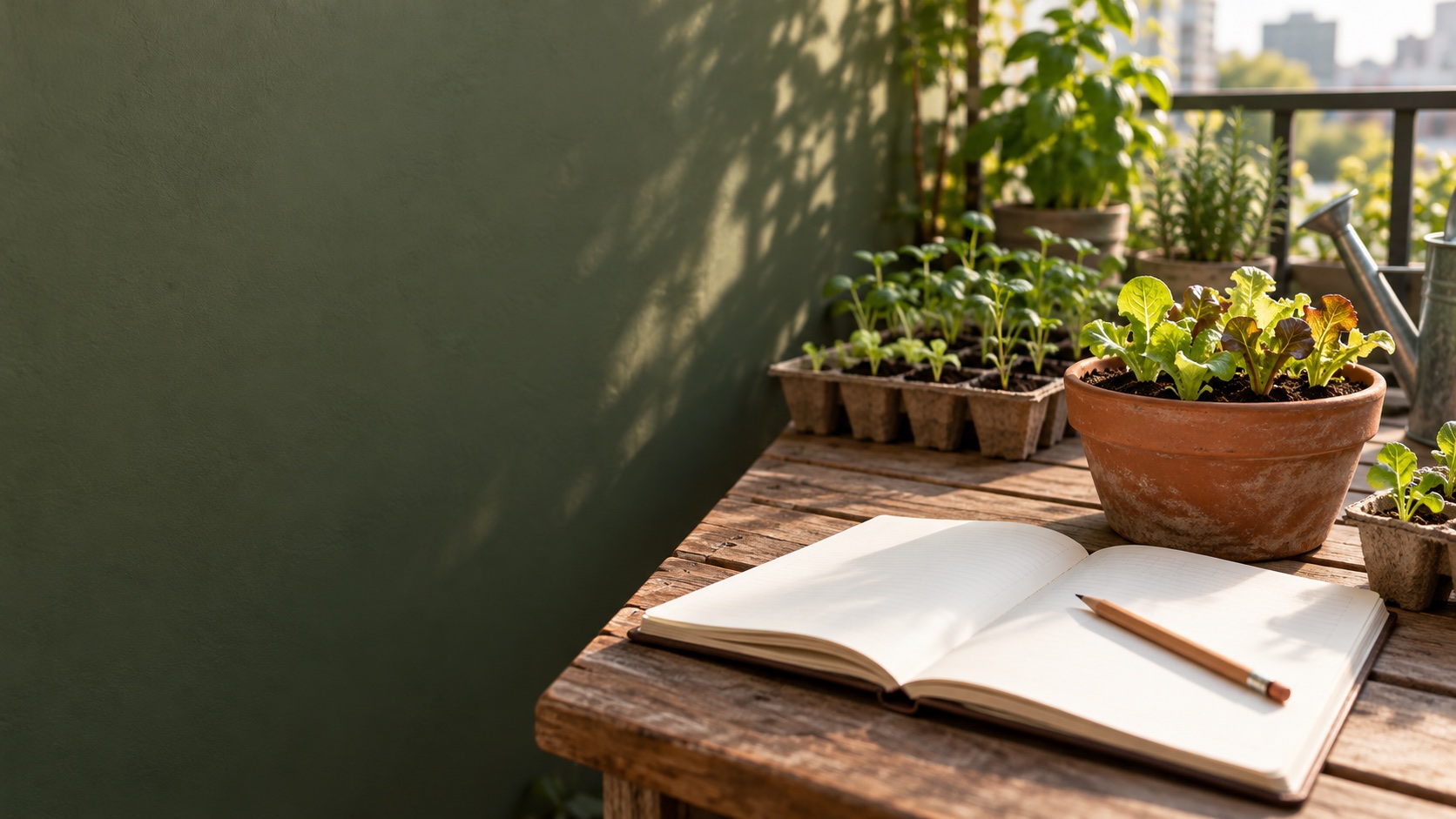
How Much Sun Does Your Balcony Really Get? A Simple Audit
Count the hours of direct sun that reach the pot, not the hours when the balcony looks bright. A roof, railing, next-door building, or tree can shade a container while the sky remains bright. Before buying tomato seeds or choosing a kit, spend one clear day measuring the spot where the plant will actually live.
The one-day sunlight log
- Put an empty pot or a marker in the intended growing position. Record the spot’s height, since a high shelf may receive light that a floor-level pot does not.
- On a reasonably clear day, check it at least once an hour from morning to late afternoon. Record direct sun on the pot’s planting area, not light on the wall behind it.
- Add up the direct-sun intervals. If the pot was shaded at 10 a.m. and sunny at 11 a.m., note the transition more precisely if you can.
- Repeat on a second day or season if a nearby tree, overhang, or neighboring building may change the pattern. This is a measurement of a place and season, not a permanent number for the address.
| Time | Direct sun on this pot? | What blocks it? |
|---|---|---|
| 8 a.m. | Yes / No | Building, railing, tree, or none |
| 10 a.m. | Yes / No | |
| Noon | Yes / No | |
| 2 p.m. | Yes / No | |
| 4 p.m. | Yes / No |
Use smaller intervals around the times the shadow moves across the pot. A phone compass can identify direction, but it cannot tell you how many hours of unobstructed sun reach that specific container.
Match the result to crops
University of Maryland Extension gives 6–8 hours of direct sun as a useful target for warm-season container crops such as tomatoes and peppers, versus roughly 3–5 hours for cool-season leafy crops such as lettuce and spinach. These are growing guidelines, not guarantees of yield. A balcony with four hours of sun is a more realistic place to try suitable greens than to expect a heavy tomato harvest.
| Measured direct sun | A more realistic first choice |
|---|---|
| Less than 3 hours | Most edible seed crops will struggle outdoors. Consider a properly sized grow light or a different location. |
| Around 3–5 hours | Try cool-season leafy greens in suitable weather; expect slower growth than in ideal light. |
| Around 6–8 hours | Warm-season crops become plausible if container volume, water, temperature, and variety also suit them. |
Do not interpret the ranges as permission to ignore climate. Lettuce can suffer in intense heat even at a sunny site, while a tomato on a cold, windy balcony may struggle despite adequate light. If you are choosing herbs, species differ: University of Maryland Extension notes that most herbs prefer substantial sun, while mint, chives, and cilantro can tolerate light shade.
What to change if the number is too low
- Move a small pot to the sunniest safe position; do not move a large, water-filled planter without checking its weight and balcony rules.
- Raise a container above an opaque railing if it can be secured against wind and falling.
- Choose a crop adapted to your measured conditions rather than repeatedly sowing a sun-loving crop in shade.
- For an indoor setup, evaluate a suitable grow light instead of assuming a bright-looking window provides the same light as outdoor sun.
Can reflected light replace direct sun? Reflective walls can brighten a space, but do not count reflected brightness as equal to a documented hour of direct sun when applying crop guidance.
Is a south-facing balcony always best? No. In the Northern Hemisphere it is often sunnier, but obstructions and overhangs can change the result. In the Southern Hemisphere the directional pattern differs. Measure the actual spot.
Sources
- University of Maryland Extension: Growing Vegetables in Containers — sun ranges, crop choices, and balcony microclimates.
- University of Maryland Extension: Care of Herbs and Starting Herbs from Seed — herb light preferences.
Related: Growing food in five hours of sun · North-facing balcony choices · Container size chart.